Friday, August 27, 2010

Tragedy on Mt. Everest

"Four hundred vertical feet above, where the summit was still washed in bright sunlight under an immaculate cobalt sky, my compadres dallied to memorialize their arrival at the apex of the planet, unfurling flags and snapping photos, using up precious ticks of the clock. None of them imagined that a horrible ordeal was drawing nigh. Nobody suspected that by the end of that long day, every minute would matter." Chapter One, p. 9

Because famed mountaineer/filmmaker David Breashears was exhibiting his photos at Asia Society in July, I became intrigued with this small detail in his biography concerning the 1996 Mt. Everest disaster. So I hunted down a copy of Jon Krakauer's account of the events, his gripping novel, Into Thin Air: A Personal Account of the Mt. Everest Disaster (1996).

All I can say is, this book was very hard to put down once I started reading. Krakauer is such a great writer, the events are nail-biting and filled with a horrific suspense, even when you know from the beginning the outcome and deaths that happened.

Krakauer was part of the team that experienced the most loss of human lives. His mission in joining Adventure Consultants expedition team was to write about the commercialization of climbing expeditions to Everest. What he experiences is more than he originally signed up for. The disastrous outcome deeply scars him, and the book is in part a memoir of the events that remind us all of just how dangerous mountaineering, and Mt. Everest, can be. Krakauer weaves into the tragedy the history of climbing on Mt. Everest and other important storylines that all shed light on the 1996 disaster- the lives and culture of the Sherpas, the evolution of climbing culture and equipment on Everest, high-altitude effects on the human body, and the personalities that have survived, or perished, in the May 1996 climbing season.
I hope you will also get a chance to check out David's photos of Mt. Everest online: http://sites.asiasociety.org/riversofice/

Friday, August 20, 2010

An Education by Lynn Barber

I recently finished An Education, a memoir by the British journalist Lynn Barber. A chapter from the book inspired the film of the same name, which was released last year and nominated for an Oscar for "Best Picture." Lynn recounts her childhood growing up in the suburbs of London, bored by her conventional surroundings and itching for a bigger, brighter life. She has her eyes set on Oxford University until, when she turns sixteen, she meets a mysterious, worldly older man, Simon, who introduces her to a life-style that seems far more interesting than college. Simon takes her to expensive restaurants, gallery auctions, weekend trips to Europe - he even charms her parents and gets their seal of their approval to date their young daughter.

Lynn and Simon soon get engaged and Lynn ditches her plans to attend Oxford. But it turns out that Simon isn't who he says he is (he's something of a conman, which the movie does a great job of depicting), and they break their engagement. Luckily, Lynn is able to take the necessary exams for Oxford and is accepted to the college. The remainder of her memoir recounts her experiences at Oxford where she spends most of her time "studying men" (she claims to have slept with fifty of them during her second year), working as an editor at Penthouse, becoming a "sex expert" (writing a book called How to Improve your Man in Bed), and becoming an esteemed newspaper journalist. Best of all, and most moving, is the section where Lynn details her husband's battle with myelofibrosis and cancer and its effect on their thirty year marriage.

Lynn was a headstrong, sexually liberated woman at a time when this was frowned upon. Her memoir offers an insightful and often humorous view on how she broke free of conventional views and became an interesting, dynamic woman in her own right.

Sunday, August 8, 2010

Commencement by J. Courtney Sullivan


I recently read Commencement as part of another book club I'm in. As the bn.com website says: "This radiant debut novel from J. Courtney Sullivan examines the deep bonds of friendship and the complex landscape facing today's young women. Celia, Bree, Sally, and April arrive at Smith College as four very different people. But the years bring them closer together, so once they graduate and face the real world, they realize they need each other more than ever."

It was an interesting read for me on many levels. One, it's set at Smith College in Northampton, MA which is a college that I had been to during summers in high school for field hockey camp, so I was extremely familiar with the area and the college. Two, it's a really interesting look at the relationships between women and the idea that while we can rely on each other for advice, encouragement, and even sometimes discouragement, there's also a level of competition that's not always discussed.

I didn't go to an all girls high school or college, but I can see why some women choose them. There's a certain comfort level that you assume you'll have where you know that they are all going through the same experience with you and can certainly relate on that level more than a man would. If you're heterosexual, there's also the fact that most people feel that not having men around would lessen your distractions and therefore, there would be more of a focus on their academic studies. And when you graduate, there's a camaraderie that it built in. But then again, I went to a mixed high school and college and don't think that I have any less camaraderie with my girl friends or any less of a lasting bond.

What do you think about all girl colleges? Are you for or against them?

Tuesday, July 27, 2010

Zeitoun

I recently finished up Zeitoun by Dave Eggers. Unlike What is the What, another Egger's novel, which is based on a true story, Zeitoun is the actual story of the Zeitoun family. Zeitoun tells the story of a Muslim family living in New Orleans during Hurricane Katrina. Eggers uses a day-by-day approach to tracking the story and the subsequent events that impact the family.

The book provides an accurate account of the historical events associated with Hurricane Katrina, while shedding light on the experience of those who stayed in New Orleans to wait out the storm. I was shocked to read about the discrimination and profiling that took place during Katrina. I was unaware that the National Guard set up a make shift prison in a New Orleans bus station and that the police were imprisoning residents of the city without cause.

This is the second book I've read about Katrina (the first was for school--Disaster: Hurricane Katrina and the Failure of Homeland Security), and I really appreciated the personal lens of Zeitoun.

Friday, July 23, 2010

Spider Eaters: Memories of the Cultural Revolution

The title of Rae Yang's memoir derives from a saying by Chinese writer Lu Xun:
Some of our ancestors must have bravely attempted to eat crabs so that we would learn they were edible. Trials with spiders were not so enjoyable. Our ancestors suffered their bitter taste and spared us their poison.

Rae Yang herself was a spider eater, when she became a Red Guard and joined the full fury that was the Cultural Revolution at the age of fifteen.

Yang's memoir is a careful balance between her recorded thoughts and memories of her younger self with her feelings and reflections of the author at present. Easy to read, the book describes Yang's life in Beijing growing up during the 1950s and through the tumultuous 60's, blending together dreams, first hand experiences and stories, real and imagined, spoken to her by relatives and friends.

Particulary interesting are the chapters describing her re-education on the pig farm in northeast China. If you read this book and are unfamiliar with Chinese history/society, it is important to note how the hukou system works. The hukou system, meaning household registration, registers citizens within China to the village, town, or city into which they are born/have residence. It limited the migration of rural immigrants into the city, thus keeping a large supply of cheap labor for state-owned companies under China's old command system. This is still partially true today. Although Yang was a Beijing resident, her move to the northeast caused her hukou to be sent there. She was in danger of remaining a peasant with no way of transferring her hukou back to Beijing. I would equate this to if you decided to go out to Kansas to become a farmer for a few years. Here in the US you can always decide that farming is not for you and return to New York City, or move to a completely new city or state for that matter. In China, you would have to apply to leave the farm, and that was very difficult. (I may have over-simplified or incorrectly stated this, but that is my understanding of it so far.)

My questions: How truthful and factual do you find memoirs to be? If written many years after the event/experience took place, do you think the added time sheds more light on the truth of the events, or erases essential pieces?

NYTimes recently published this article about preserving the history of the Cultural Revolution.

Tuesday, July 13, 2010

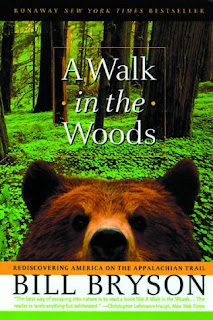
At Home in the Woods: Reading Bill Bryson's A Walk in the Woods

In May, I came home to New York after almost two years abroad on the other side of the world. Thrust back among once familiar sights and sounds, immersed again in the English language, awashed in American culture and media, I felt extremely lost. I had always heard about the culture shock one experiences when living in a foreign country. It was mentioned during a Fulbright conference that actually it was the re-culture shock that was far worse than the initial culture shock. I didn’t realize until I moved back home just how right this was.

To re-acquaint myself with my old American life, I decided one day to go for a walk in Harriman State Park near my house in New York. The woods felt comforting and familiar, a place I had walked through since I was as child. With vivid, bright, new spring greens enveloping me, I felt once again grounded, a connection between a place strongly anchored to my sense of “home,” and an activity I did frequently in Hong Kong, China and the US: hiking.

Along the trail, I found a signpost jabbed into the ground stating that I was actually walking along the Appalachian Trail. The “AT” is that famous trail which runs an unimaginable 2175+ miles, give or take, from Maine to Georgia. It was amazing to think that if I stayed on this trail, I could end up in either of those states. Then I began imagining actually trying to hike the whole trail, and how I would do it. How much food would I have to bring? How would I ever carry enough stuff for this exponentially long hiking trip?

In June, while helping to clean out old books at my father’s house for a yard sale, I found the copy of Bill Bryson’s A Walk In The Woods, a travel memoir of the author’s experience along the AT. I had bought the book for Dad a few Christmases ago (although he presumably never read it), and I decided to re-gift it back to myself and find answers to all my AT questions.

Bryson had the crazy idea to hike the entire AT after a day hike on the portion of the AT trail that ran near his house in Hanover, NH. Bryson too had just returned to the US after having spent 20 years in England. He was going to hike the trail to re-discover the country of his birth.

The book got me laughing from the start.

"So I decided to do it [hike the AT]. More rashly, I announced my intention - told friends and neighbors, confidently informed my publisher, made it common knowledge among those who knew me. Then I bought some books... It required only a little light reading in adventure books and almost no imagination to envision circumstances in which I would find myself caught in a tightening circle of hunger-emboldened wolves, staggering and shredding clothes under an onslaught of pincered fire ants, or dumbly transfixed by the sight of enlivened undergrowth advancing towards me, like a torpedo through water, before being bowled backwards by a sofa-sized boar with cold beady eyes, a piercing squeal, and slaverous, chopping appetite for pink, plump, city-softened flesh."


It also brought back memories of my grizzly bear encounter in Yellowstone Park in May too.

"My particular dread--the vivid possibility that left me staring at tree shadows on the bedroom ceiling night after night--was having to lie in a small tent, alone in an inky wilderness, listening to a foraging bear outside and wondering what its intentions were. I was especially riveted by an amateur photograph in Herrero's book, taken late at night by a camper with a flash at a campground out West. The photograph caught four black bears as they puzzled over a suspended food bag. The bears were clearly startled but not remotely alarmed by the flash. It was not the size or demeanor of the bears that troubled me--they looked almost comically nonaggressive, like four guys who had gotten a Frisbee caught up a tree--but their numbers. Up to that moment it had not occurred to me that bears might prowl in parties. What on earth would I do if four bears came into my camp? Why, I would die, of course. Literally shit myself lifeless. I would blow my sphincter out my backside like one of those unrolling paper streamers you get at children's parties--I daresay it would even give a merry toot--and bleed to a messy death in my sleeping bag."

Bryson also balances his personal narratives with interesting side-stories and history abou the Appalachian Trail. I learned many interesting things about America I never knew.

Did you know....?

1. What happened to the American chestnut tree?

2. What is largest job the US Forest Service undertakes?

3. What do you do if you see a bear?

The best part about the book for me was that Bryson, like myself, is not an extreme hiker or mountaineer. He is a simple every-day man, attuned and accustomed to the convenience of modern day life, in all its fast-food, shopping mall, parking lot filled glory. The second best part of the book is his equally hilarious companion, Katz.

I read the book on my commute between New Jersey and New York City. While rather ugly industrial landscapes, land flat as the eye could see, and suburban sprawl in 360 degrees rolled by the bus window, I was transported to one of my favorite places to be: lost among the trees of a New England forest.
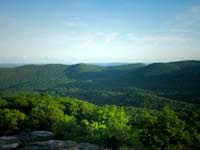
Just this past weekend, inspired by the book, I took to the woods once again. Armed with an old hiking book with trail maps (circa 1971) I also found in my Dad’s collection, I set out on a four and a half hour hike through Bear Mountain. I walked the Appalachian Trail for a few hours, and thought about how Bryson described it. Hiking alone was a new adventure ( I admit I was slightly worried about getting murdered), but I also at once felt calm and peaceful, despite the sounds of gunfire practice from West Point and the rip-roaring bursts of noisy motorcycles that broke the silence. I spotted a pair of wild turkey, saw wild raspberries, a bright orange shelf-like tree mushroom (Laetiporus), and a wasp nest. Sweaty and tired, I was a hiker again, and I was at home.

Friday, July 9, 2010

Let the Great World Spin by Colum McCann


I really enjoyed this novel. It’s been on my reading list ever since I read glowing reviews of it from the New York Times and various blogs last year. It’s set in New York City in 1974 and centers around the day Philip Petite walked across a wire set between the World Trade Center towers (Man on Wire, a great documentary that came out a couple years ago details how Petite planned and executed his extraordinary walk).

The novel follows a set of characters whose lives intersect on that day and in the months and years that follow. Each chapter is told from the perspective of a different character – a young Irish monk, a prostitute, a wealthy Upper East Side housewife, a judge, a hippie painter, etc. They all come from very different walks of life, and it’s interesting to watch their lives intertwine with one another. I loved the descriptions of New York City, how different and kind of dangerous it was back then. The novel also touches upon 9/11 in a subtle way, I think. It shows a day that could have turned out tragic (i.e. what if Philip Petite had fallen or been knocked down) but turned out to be uplifting (his walk brought thousands of people on the streets of the city, cheering) unlike what happened decades later. I highly recommend this book; it's a really great read.