Showing posts with label Non-Fiction. Show all posts

Friday, December 24, 2010

Compare and Contrast: The Blue Sweater and The 10 Women You'll Be Before You're 35

It seems like we've taken a break from blogging (although admittedly, I'm usually a bit delinquent), but I figured I would start it back up since I will miss our next meeting when we discuss The Blue Sweater: Bridging the Gap Between Rich and Poor in an Interconnected World by Jacqueline Novogratz. I really enjoyed The Blue Sweater. I admire Novogratz's work and sincere ambition to change the world. My one challenge with the book was that at times, Novogratz made it seem too easy--that anyone could go from international banking to the Rockefeller Foundation to beginning one's own nonprofit. Clearly, Novogratz had unusually amazing opportunities--and to her credit acknowledges them as such--but for those if us without those opportunities, is giving to Kiva enough?

I also recently read a book that I would categorize as Self-Help-Chick Lit: The 10 Women You'll Be Before You're 35 by Alison James. Boy, did these two books contrast! On one hand Novogratz is out truly changing the world in her 20s and early 30s, and James is writing about the party girl, the body conscious babe and the crisis chick. In her book, James describes stereotypes of women that we will be at some point in our 20s and 30s. And while my personality or lifestyle never encompassed any individual stereotype, I certainly relate to elements of almost every "woman that I will be" described by James.

Unlike me, Novogratz does not seem to share many of the qualities described by James. She seems to be above it all. I am not sure if she is really above it all or if that is just the perception I get from the book. (And I am leaning toward the latter.) Although Novogratz does not deny her weaknesses in The Blue Sweater, at times, she seems a little too good to be true.

What do you think? Can we all aspire to be like Novogratz and change the world? How do we balance our desire to do good with our real life idiosyncrasies?


Friday, August 27, 2010

Tragedy on Mt. Everest

"Four hundred vertical feet above, where the summit was still washed in bright sunlight under an immaculate cobalt sky, my compadres dallied to memorialize their arrival at the apex of the planet, unfurling flags and snapping photos, using up precious ticks of the clock. None of them imagined that a horrible ordeal was drawing nigh. Nobody suspected that by the end of that long day, every minute would matter." Chapter One, p. 9

Because famed mountaineer/filmmaker David Breashears was exhibiting his photos at Asia Society in July, I became intrigued with this small detail in his biography concerning the 1996 Mt. Everest disaster. So I hunted down a copy of Jon Krakauer's account of the events, his gripping novel, Into Thin Air: A Personal Account of the Mt. Everest Disaster (1996).

All I can say is, this book was very hard to put down once I started reading. Krakauer is such a great writer, the events are nail-biting and filled with a horrific suspense, even when you know from the beginning the outcome and deaths that happened.

Krakauer was part of the team that experienced the most loss of human lives. His mission in joining Adventure Consultants expedition team was to write about the commercialization of climbing expeditions to Everest. What he experiences is more than he originally signed up for. The disastrous outcome deeply scars him, and the book is in part a memoir of the events that remind us all of just how dangerous mountaineering, and Mt. Everest, can be. Krakauer weaves into the tragedy the history of climbing on Mt. Everest and other important storylines that all shed light on the 1996 disaster- the lives and culture of the Sherpas, the evolution of climbing culture and equipment on Everest, high-altitude effects on the human body, and the personalities that have survived, or perished, in the May 1996 climbing season.
I hope you will also get a chance to check out David's photos of Mt. Everest online: http://sites.asiasociety.org/riversofice/

Tuesday, July 27, 2010

Zeitoun

I recently finished up Zeitoun by Dave Eggers. Unlike What is the What, another Egger's novel, which is based on a true story, Zeitoun is the actual story of the Zeitoun family. Zeitoun tells the story of a Muslim family living in New Orleans during Hurricane Katrina. Eggers uses a day-by-day approach to tracking the story and the subsequent events that impact the family.

The book provides an accurate account of the historical events associated with Hurricane Katrina, while shedding light on the experience of those who stayed in New Orleans to wait out the storm. I was shocked to read about the discrimination and profiling that took place during Katrina. I was unaware that the National Guard set up a make shift prison in a New Orleans bus station and that the police were imprisoning residents of the city without cause.

This is the second book I've read about Katrina (the first was for school--Disaster: Hurricane Katrina and the Failure of Homeland Security), and I really appreciated the personal lens of Zeitoun.

Tuesday, July 13, 2010

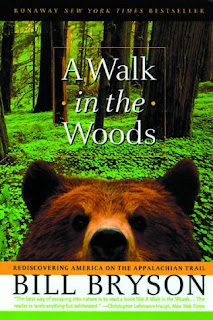
At Home in the Woods: Reading Bill Bryson's A Walk in the Woods

In May, I came home to New York after almost two years abroad on the other side of the world. Thrust back among once familiar sights and sounds, immersed again in the English language, awashed in American culture and media, I felt extremely lost. I had always heard about the culture shock one experiences when living in a foreign country. It was mentioned during a Fulbright conference that actually it was the re-culture shock that was far worse than the initial culture shock. I didn’t realize until I moved back home just how right this was.

To re-acquaint myself with my old American life, I decided one day to go for a walk in Harriman State Park near my house in New York. The woods felt comforting and familiar, a place I had walked through since I was as child. With vivid, bright, new spring greens enveloping me, I felt once again grounded, a connection between a place strongly anchored to my sense of “home,” and an activity I did frequently in Hong Kong, China and the US: hiking.

Along the trail, I found a signpost jabbed into the ground stating that I was actually walking along the Appalachian Trail. The “AT” is that famous trail which runs an unimaginable 2175+ miles, give or take, from Maine to Georgia. It was amazing to think that if I stayed on this trail, I could end up in either of those states. Then I began imagining actually trying to hike the whole trail, and how I would do it. How much food would I have to bring? How would I ever carry enough stuff for this exponentially long hiking trip?

In June, while helping to clean out old books at my father’s house for a yard sale, I found the copy of Bill Bryson’s A Walk In The Woods, a travel memoir of the author’s experience along the AT. I had bought the book for Dad a few Christmases ago (although he presumably never read it), and I decided to re-gift it back to myself and find answers to all my AT questions.

Bryson had the crazy idea to hike the entire AT after a day hike on the portion of the AT trail that ran near his house in Hanover, NH. Bryson too had just returned to the US after having spent 20 years in England. He was going to hike the trail to re-discover the country of his birth.

The book got me laughing from the start.

"So I decided to do it [hike the AT]. More rashly, I announced my intention - told friends and neighbors, confidently informed my publisher, made it common knowledge among those who knew me. Then I bought some books... It required only a little light reading in adventure books and almost no imagination to envision circumstances in which I would find myself caught in a tightening circle of hunger-emboldened wolves, staggering and shredding clothes under an onslaught of pincered fire ants, or dumbly transfixed by the sight of enlivened undergrowth advancing towards me, like a torpedo through water, before being bowled backwards by a sofa-sized boar with cold beady eyes, a piercing squeal, and slaverous, chopping appetite for pink, plump, city-softened flesh."


It also brought back memories of my grizzly bear encounter in Yellowstone Park in May too.

"My particular dread--the vivid possibility that left me staring at tree shadows on the bedroom ceiling night after night--was having to lie in a small tent, alone in an inky wilderness, listening to a foraging bear outside and wondering what its intentions were. I was especially riveted by an amateur photograph in Herrero's book, taken late at night by a camper with a flash at a campground out West. The photograph caught four black bears as they puzzled over a suspended food bag. The bears were clearly startled but not remotely alarmed by the flash. It was not the size or demeanor of the bears that troubled me--they looked almost comically nonaggressive, like four guys who had gotten a Frisbee caught up a tree--but their numbers. Up to that moment it had not occurred to me that bears might prowl in parties. What on earth would I do if four bears came into my camp? Why, I would die, of course. Literally shit myself lifeless. I would blow my sphincter out my backside like one of those unrolling paper streamers you get at children's parties--I daresay it would even give a merry toot--and bleed to a messy death in my sleeping bag."

Bryson also balances his personal narratives with interesting side-stories and history abou the Appalachian Trail. I learned many interesting things about America I never knew.

Did you know....?

1. What happened to the American chestnut tree?

2. What is largest job the US Forest Service undertakes?

3. What do you do if you see a bear?

The best part about the book for me was that Bryson, like myself, is not an extreme hiker or mountaineer. He is a simple every-day man, attuned and accustomed to the convenience of modern day life, in all its fast-food, shopping mall, parking lot filled glory. The second best part of the book is his equally hilarious companion, Katz.

I read the book on my commute between New Jersey and New York City. While rather ugly industrial landscapes, land flat as the eye could see, and suburban sprawl in 360 degrees rolled by the bus window, I was transported to one of my favorite places to be: lost among the trees of a New England forest.

Just this past weekend, inspired by the book, I took to the woods once again. Armed with an old hiking book with trail maps (circa 1971) I also found in my Dad’s collection, I set out on a four and a half hour hike through Bear Mountain. I walked the Appalachian Trail for a few hours, and thought about how Bryson described it. Hiking alone was a new adventure ( I admit I was slightly worried about getting murdered), but I also at once felt calm and peaceful, despite the sounds of gunfire practice from West Point and the rip-roaring bursts of noisy motorcycles that broke the silence. I spotted a pair of wild turkey, saw wild raspberries, a bright orange shelf-like tree mushroom (Laetiporus), and a wasp nest. Sweaty and tired, I was a hiker again, and I was at home.

Thursday, April 1, 2010

A People's History of the United States: 1492-Present


I'd like to recommend Howard Zinn's A People's History of the United States. The book covers major moments in American history starting from 1492 (Christopher Columbus's discovery of America, The First and Second World Wars, Vietnam, etc). The version I read ends in the 1970s, but there's an updated version that goes through the 1990s. Zinn writes about hisorical events from the perspective of how they affected everyday people. For example, when he writes about Columbus, he focuses more on the Native Americans, showing how they struggled and failed to hold to their land. He also argues that it's the American people who've shaped the laws of the country rather than political leaders. He shows how working-class people played a pivitol role in ensuring that the government passed Civil Rights, Women's Rights and Worker's laws amongst a host of other important legislation. I like Zinn's writing style a lot; it's clear and simple, not stuffy at all. Really enjoyed the book and discovering new things I was unaware of in our history.

Tuesday, March 2, 2010

Got Faith?

I remember reading Tuesdays with Morrie by Mitch Albom when I was 16. Even as a teenager, I found Albom's portrayal of his teacher and mentor Morrie and his life lessons meaningful and inspiring. I found Have a Little Faith: A True Story, Albom's most recent novel, to be equally as inspiring.

After being asked to write and deliver the eulogy for his childhood rabbi "Reb" (Reb makes this request himself of Albom), Albom spends eight years learning about Reb and the meaning of faith. In his recounting of his meetings with Reb, Albom intertwines the story of a Detroit Pastor, Henry. Much like Morrie, Have a Little Faith is full of life lessons. And although the main characters in the novel are a rabbi and a pastor, it is not about religion--it is about faith and what it means to have faith. Albom does not describe himself as religious before his meetings with Reb, and I'm not sure he would describe himself as religious after those meetings.

What do you think about faith? Is it something intricately tied into religion, or is it something that you have have even without religious beliefs?

Saturday, February 20, 2010

Just Kids


I recently finished Just Kids, a memoir by the rock singer and poet Patti Smith and really enjoyed it. In her memoir, Smith recounts moving from New Jersey to New York City when she was 19 in the late 60s with a dream of becoming an artist. She is unsure of what type of artist she wants to be, but desires to make a name for herself in art. She ends up meeting a cute boy named Robert Mapplethorpe, who also wants to be an artist, and the book charts their rise into the art and music world. Smith struggled quite a bit during her first few yeas in the city; she had little money and found herself sleeping in Central Park for a few nights. Somehow, she held on to her dream and, since then, she has developed a successful career. I think her music's pretty great.

I loved how Smith describes New York City in the 60s - chockfull of so much creative energy. People seemed really energized to create art, music and be involved in politics. Smith also describes other artists she encounters during that time: she meets Jimi Hendrix in front of his recording studio in the East Village, parties with Janis Joplin in a hotel room, hooks up with the playwright Sam Shepard at a concert. Smith wasn't famous at the time, but she was still able to talk to and hang out with pretty famous people. I don't imagine she'd have the same access to such people today. There seemed to be less of a divide between famous and non-famous people in those days.

I don't read memoirs often, but I liked this one so much I'd like to read more. Are there any memoirs you'd recommend reading?

Friday, January 29, 2010

Factory Girls by Leslie Chang

Imagine this is your workday:

You wake up from your bunk bed in a cramped dorm room for eight, and with the morning alarm promptly ringing at 6am you are up and fighting for use of the bathroom with all the other women on your dorm floor. By 7am you have eaten in the factory cafeteria along with the other 50,000 employees in the factory complex. That’s right- the factory employs over 70,000 people, more than the population of a small American city! After breakfast you are stationed on your assembly line team. Your task: to cut the upper materials that will eventually become the body for sneakers of famous brands like Puma, Nike, Adidas, and many others. You do this for 12 hours everyday, with a 1 hour lunch break and dinner break. You finish work by 9 or 10pm and return to your dorm to begin a new day tomorrow. It’s only Monday, and you still have 5 more days of work before your one Sunday off. You make roughly 1,000 rmb a month- $160.


Such is the life of many factory girls in China, yet their move from the farming villages into working conditions such as these are seen as a success and a triumph for millions of migrant women.


Leslie Chang offers a fascinating glimpse into the lives of real young migrant women in China, girls our age, who move from their rural villages to bustling centers like Shenzhen, Dongguan and Guangzhou, all of a two hour train ride away from Hong Kong. Simultaneously, Chang also weaves in her family’s own personal history in China. And for once it felt very satisfying to get a Chinese American’s perspective on all the happenings of modern China. She is also the wife of writer Peter Hessler, who wrote two great books on teaching and living in China- Buki has the one I traded at our book swap, Oracle Bones.


Whenever I read books about China, I always reflect upon my own experiences there, and I feel like I’m re-living much of it all over again. Chang provides amusing and humorous glimpses into facets of Chinese society I may never encounter, making the book a fast and entertaining read. I also really appreciated the way in which she worked in the personal story of her family, as I felt it was something I have been wanting to do with my own experiences in learning about my family’s history in China and Hong Kong.


Another favorite scene in the book is when she writes about one of the main characters who works in a handbag factory. It turns out that the handbag factory makes purses for Coach, but the girl and her fellow workers never really understand the true value of how much the bags are worth, trading them among friends and never really using them.


Hope you will all get a chance to read this!

Sunday, November 8, 2009

Non-Fiction Fun

Thanks, Tiff, for your posts about the Hurricane and Northern Lights. It saddens me that I don't have time for pleasure reading, and I am looking forward to tackling the growing stack of books on might night table when I am off from school in January.

I'm really enjoying being back in school, and while the first half of the semester included some not so fun books (all 85 of the Federalist Papers, for example), I am really enjoying the books assigned in the second half of my Intro to Public Affairs course.

I've read most of What You Should Know about Politics...But Don't by Jessamyn Conrad. Though not the most sophisticated book (I like to think that Conrad, who is getting her PhD in Art History, wrote this book as a guide to politics for art history majors), it explains all sorts of political issues very well--and to her credit, Conrad does explain the many sides of political issues. The book is not entirely non-partisan, as it claims to be, but it does provide a well-rounded view of what is going on in American political life.

On the "I didn't know America had a eugenics program" front, I am currently about a third of the way through of War Against the Weak by Edwin Black. So far, it is incredibly fascinating. I had no idea that Germany learned about eugenics from the US! And with all of the debate over "human engineering" (did anyone see this week's Private Practice), the books feels incredibly relevant. I'll post more when I am done, but if you enjoy history, this is a good one.

Sunday, November 1, 2009

The 16th Round by Rubin "Hurricane" Carter

We were supposed to read this book as the first in our "novel to film" round, but as luck would have it (or rather, lack of luck), none of us could get our hands on a copy in time, so we moved on to the next book on the list. I was still interested in reading this book, however, so I kept it on my library queue and read it after I was done with the bookclub book of the month.

I had seen the film with Denzel Washington, so I was vaguely familiar with Carter's story, but after now having read the novel, I see that the film definitely left out a lot of the events of his life in order to make a more sympathetic character out of Carter. You don't see Denzel Washington mugging people (or at least that I can remember...I'm going to netflix it so that I can refresh my memory...)

Considering that the novel is a memoir more than a biography, I couldn't help but question some of the things that Carter tells us. I'm not saying that I don't believe Carter's story to a certain extent because I know that racism plays an big part in the relations between many different ethnicities, but it seems that every time something happens to him, he blames it on the prejudice of others. He never seems to take responsibility for his own behavior (which includes mugging and robbing people) and instead tries to justify his actions by constantly reminding you of the circumstances of what most, if not all, Black people during that time were going through. Not everyone made the same choices that he did.

As for the murders that he was given the life sentences for, I believe him when he says that he didn't commit those crimes, if only because his life seemed to be going in a completely different direction than most of his life was heading and he seems to be on the right path. Married with a child on the way, a career that was flourishing...he'd have had to be an idiot to mess that up.

I found the novel to be an interesting read (especially since my dad grew up in Paterson and my grandmother still lives there...I was even able to picture some of the places that Carter mentions) and I was definitely intrigued by Carter, but I don't think that I ever allowed myself to truly open up to Carter. Perhaps that was because I never felt like he was able to truly open up to us...his audience.

Has anyone else read this novel? What were your thoughts? Do you think that Carter was able to give an objective view of his own life?

Monday, September 14, 2009

Good Girls Should Go Bad?

Read about this new book by author Rachel Simmons, The Curse of the Good Girl: Raising Authentic Girls with Courage and Confidence.

Here's an excerpt from the article:

"Our culture is teaching girls to embrace a version of selfhood that sharply curtails their power and potential. In particular, the pressure to be “Good”—unerringly nice, polite, modest, and selfless—diminishes girls’ authenticity and personal authority.

The Curse of the Good Girl erects a psychological glass ceiling that begins its destructive sprawl in girlhood and extends across the female life span, stunting the growth of skills and habits essential to becoming a strong woman. This book traces the impact of the curse on girls’ development, and provides parents with the strategies to break its spell."

Saturday, August 22, 2009

Peter Hessler's River Town

So while traveling around China for a month, I had a lot of time to read on the 14 hour train rides between cities. I finished off Peter Hessler's River Town. He was a Peace Corps volunteer back in the late 1990s, the first batch sent to China, where he taught English at a small sleepy town along the Yangtze River.

If there is one book I would recommend to summarize many of my own experiences and feelings about China, it would be this book. I really hope you all get a chance to read it. It's entertaining and insightful about being a foreigner in China, Chinese history and culture, and the growing pains and successes of the nation and its people in modern times.

Happy summer reading!

Saturday, April 11, 2009

The Last Lecture


Hey Ladies!  Sorry I couldn't make it to the meeting, but I hope you all had a great time discussing the book.  Here are some of my thoughts...

I had seen the video of Randy Pausch's "Last Lecture" online last year and was completely blown away by it.  It was funny, insightful, enduring, thought-provoking, just all of the things that I'm sure he was hoping his audience would take from it.  So when it was decided that we would read the book, I thought it would just be a repeat of the recorded lecture.  I was pleasantly surprised when I began reading the book and found that it gave much more insight than even the video. There was reflection there that couldn't be captured in such a short presentation time.  

It's terrible to say, but I agree with him when he says that he was lucky to have gotten cancer. 
Not to say that he was lucky to be dying from a terrible disease, but he was able to live long enough to leave his kids with videos and letters and a true sense of how much he loved them. Had he been hit by a bus or something, they would have only been able to rely on what others said about him, not first hand information.  I think that's the most heart-breaking thing about the entire book.  Here he is giving advice to the masses, but really it's him giving advice to his kids.  He loved them so much that he wanted to give all that he could while he could.  I couldn't help but cry at the end when he reveals to his audience that he's doing all of this for his kids.  

Reading this book really makes you take a hard look at your own life and how you should be grateful for every moment you have.  Not only that, but you should always follow your dreams and not be discouraged if at first you don't succeed.  He talks about the fundamentals that everyone should know, but that we tend to forget or set aside for other things as we get older. 

What did everyone else take away from this book?  Was there a particular story or anecdote that hit a nerve with anyone?  Any other thoughts on the book?

Tuesday, March 3, 2009

The Film Club

At our last meeting, we discussed "The Film Club," a memoir by David Gilmour.  One the surface, the book can be seen as just a story about a father's unusual tactics to get his son to go back to school.  But there is so much more going on here.  The book is as much about the son as it is about the father.  Gilmour's struggle to steer his son in a more positive direction forces him to recognize his own short-comings and ultimately, I think he grows and learns as much as, if not more than, his son.  

One of the things that we discussed and all thought was a unique and admirable thing was Gilmour's relationship with his wife and ex-wife.  He's able to do what most people only wish they could which is to put aside any grievances they may have after a relationship is over and work to build a new kind of relationship.  This is especially crucial when dealing with relationships that involve children.  Even Gilmour's new wife is able to join in the fold and not feel intimidated by the obvious strong bond that Gilmour continues to have with his ex-wife.

Another topic that came up was whether or not we believed that Gilmour  allowing his son to quit high school was a good thing.  There were view points on both sides of the spectrum.  

For the purposes of the blog, here are a few questions:

How did Gilmour's plan to get his son to go back to school ultimately work?  

How did Gilmour's plan affect his relationship with his son?

Tuesday, February 10, 2009

Warlord: No Greater Friend, No Worse Enemy


Since this dialogue hasn't been started yet, I thought I'd go ahead and get us going so that those who couldn't make it to the meeting can chime in.

My first thoughts as I finished the book were that I didn't like it and that I didn't like Ilario.  The man that I was supposed to have sympathy for came off as arrogant and self-righteous.  Believing that he wasn't responsible for the charges that were brought against him was hard because I didn't "like" him.  But that's not enough to convict someone of a crime.

To do what they have to do in the armed forces, a certain amount of arrogance and bravado is necessary.  You have to be confident at all times that you have what it takes to succeed in your missions and without it, everyone and everything is lost.  

But it was because of this arrogance that I felt like I never really got a look beyond the facade he portrayed.  There was only one or two moments where I felt he was letting his guard down just a little, but then he would bring it all the way back up moments later.

I think that was my biggest issue with his story even though I know that it shouldn't be the deciding factor in his conviction.

What were everyone else's thoughts?